

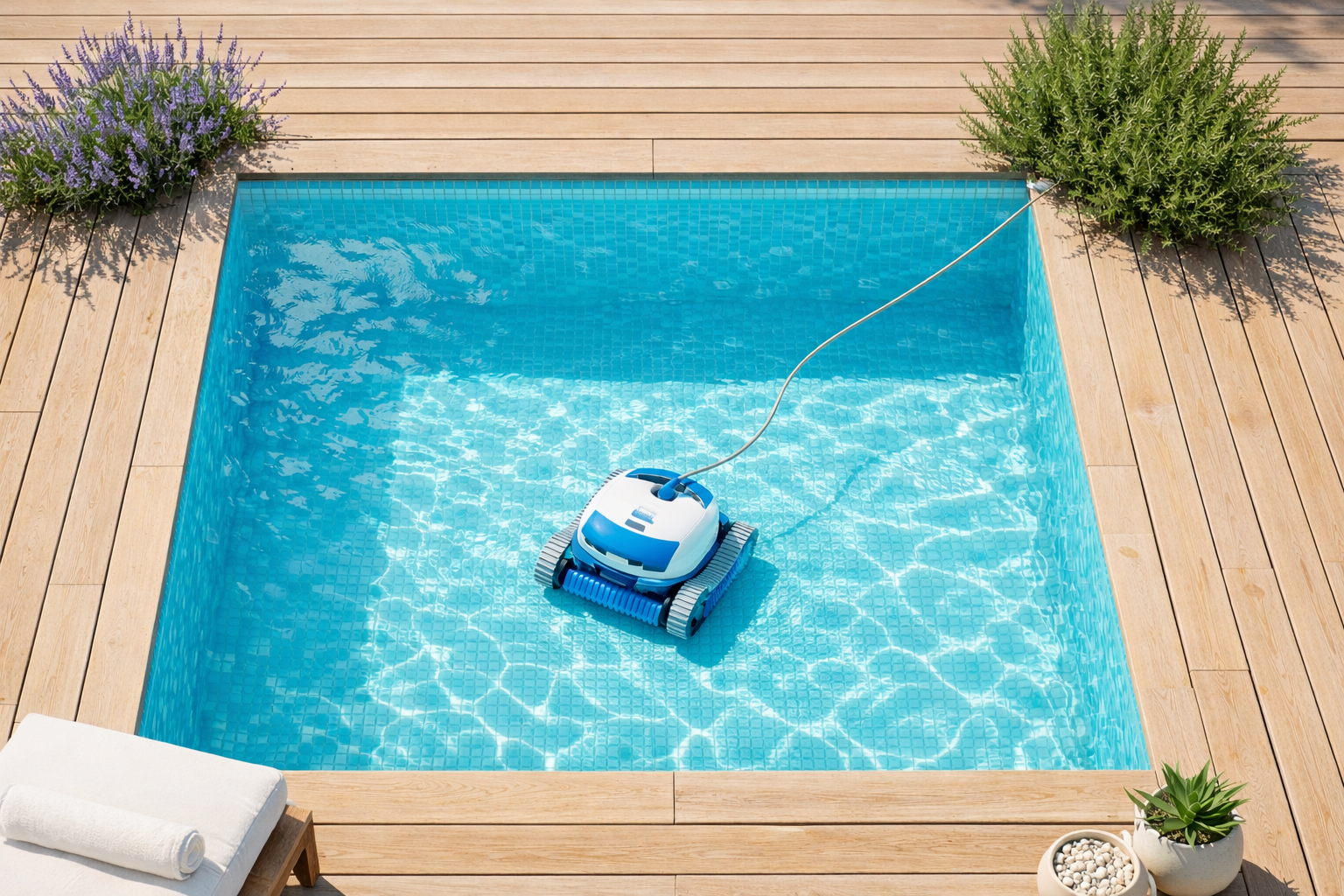
Spring arrives, bringing the same question as every year: how to keep the bottom and walls of the pool clean without spending hours on manual labor? A pool cleaning robot is the most effective answer: it vacuums dirt, brushes surfaces, and filters water autonomously while you take care of other things. The problem is that the options in 2026 are vast — models with cables, cordless, with mobile apps, for small or large pools — and making the right choice is not always easy. In this guide, we explain what you need to consider when buying the cleaning robot you really need.
Types of Cleaning Robots: Which One Fits Your Pool?
Before comparing brands, it's important to understand the three main families of automatic cleaners you will find on the market:
Electric Robots (Autonomous)
They operate with their own motor and internal filtration system. They connect to the electrical grid via a low-voltage transformer and navigate the pool basin in a programmed manner. They are the most comprehensive: they clean the bottom, walls, and waterline. Ideal for private or community pools that seek the best results with minimal effort.
Battery-Powered Robots (Cordless)
The category that has grown the most in the last two years. They eliminate the cord, charge in their base, and are launched into the water. Their main advantage is convenience; their limitation is autonomy (between 60 and 120 minutes depending on the model). They are perfect for pools up to 80-100 m² and users who value simplicity above all.
Hydraulic Cleaners (Suction or Pressure)
They connect to the pool's filtration system. They are more economical but depend on the pump's power and only clean the bottom. They can be a valid option for small pools with a tight budget.
Five Key Criteria Before Buying a Cleaning Robot
With so many options available, these are the factors that truly make a difference when choosing:
Size and Shape of the Pool. Measure the surface area of the basin in square meters. Manufacturers indicate the maximum recommended surface area. If your pool has irregular shapes, Roman steps, or a beach entry, look for models with smart navigation (gyroscope or wall sensors).
Type of Lining. Tiles, liner, polyester, concrete… Some brushes are specific for delicate surfaces. Check compatibility before purchasing.
Filtration Capacity. A good robot captures particles as small as 2 microns. Ultra-fine filtration is important if the pool is surrounded by vegetation or receives a lot of dust.
Corded or Cordless. The cord offers unlimited autonomy; the battery provides convenience. Consider which is more important in your case.
Extra Features. App control, programmable cycles, full filter indicator, transport cart… They are not essential, but they enhance the user experience.
How Much Does a Cleaning Robot Cost in 2026?
The price range is broad and directly depends on the type of technology and features:
Basic hydraulic cleaners start at around €80-150. They fulfill their function for small pools, although they require the filtration pump to be running.
Mid-range electric robots with a cord range from €400 to €900. In this range, you will find models with programmed navigation, wall cleaning, and easy-access filters, which is where the best value for money is concentrated for most family pools.
Next-generation cordless robots and high-end electric models can exceed €1,000-1,500, with features such as basin mapping, remote control via app, and specific cycles for the bottom, walls, or waterline.
At nousitan.com, we work with leading brands, and you can compare models with detailed technical specifications to find the one that fits your pool and budget.
Basic Maintenance to Make Your Robot Last Longer
A cleaning robot is an investment, and with some simple care, you can significantly extend its lifespan:
After each use, remove the robot from the water, empty and rinse the filter or bag with fresh water. Leaving residues in the filter reduces suction capacity and can generate bad odors.
Check the cord periodically (for corded models). Untangle it before storing to avoid twisting and internal damage. Many robots come with an anti-tangle system, but it's good to check it anyway.
Store the robot in a dry, shaded place. Direct exposure to sunlight degrades plastics and rubber on the rollers. If the manufacturer includes a cart or stand, use it: it facilitates drying and protects the equipment.
Replace worn parts — brushes, rollers, filters — according to the manufacturer's instructions. At nousitan.com, you can find original and compatible spare parts for the leading brands on the market.
When is the Best Time to Buy a Cleaning Robot?
The short answer: now, in April. The pool season in Spain starts between May and June depending on the area, and having the robot ready before the first setup of the basin allows you to start the season with optimal water conditions from day one.
Additionally, buying before the peak demand in June-July has practical advantages: greater stock availability, faster shipping, and, in some cases, pre-sale prices or early season promotions.
If you already have an old cleaner that has lost power or does not clean the walls, April is also the ideal time to upgrade before the intensive use of the pool begins.
Conclusion
Choosing the right cleaning robot depends on the size of your pool, the type of lining, and the level of convenience you seek. The important thing is to invest in a model that fits your real needs and to maintain it properly to get the most out of it for many seasons. At nousitan.com, we have been advising professionals and individuals for over 20 years on everything related to pools: come in, compare, and if you have questions, our team will help you choose.
What is the best cleaning robot for a small pool? For pools up to 40-50 m², a compact electric robot or a cordless battery model is usually the best option. They are lightweight, easy to handle, and their cleaning cycle (60-90 minutes) is sufficient to cover the entire surface.
How long does the battery of a cordless cleaning robot last? Most battery-powered robots offer between 60 and 120 minutes of autonomy per charge, depending on the model and suction power. This is usually sufficient for pools up to 80-100 m². A full charge takes between 3 and 5 hours.
Does a cleaning robot also clean the walls of the pool? Mid-range and high-end electric robots do clean walls and even the waterline. Basic hydraulic models and some economical cordless robots only clean the bottom. Check the specifications before buying if wall cleaning is important to you.
How often should the cleaning robot be used? During the bathing season, it is recommended to use it 2 to 3 times a week. If the pool is surrounded by trees or receives a lot of use, a daily cycle may be necessary. Off-season, once a week or every two weeks is sufficient if the pool is covered.
Can the cleaning robot be left in the pool? It is not recommended. Although some manufacturers allow it for short periods, prolonged exposure to chlorine and UV rays deteriorates plastic components and electronics. Ideally, the robot should be removed after each cycle, rinsed, and stored in a dry place.
How much does a good cleaning robot cost in 2026? A good quality corded electric robot ranges from €400 to €900. Next-generation cordless models start at around €500, and high-end models can exceed €1,500. Hydraulic cleaners are more economical, starting at €80, but with more limited features.
Share:
Chlorine for Pools: Types, Dosage, and Mistakes You Should Avoid This Summer
How to Prepare Your Pool for Summer: Complete Step-by-Step Checklist